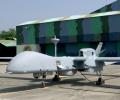
The Indian government is planning to develop an unmanned combat search and rescue aircraft for the Indian Air Force, designed to operate autonomously and in challenging terrains.
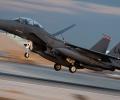
The military command clarified in a statement published on X that the aircraft were engaged in error during active combat operations on Sunday.

Government officials are reportedly apprehensive that the 30,000 to 40,000 US troops currently deployed within the region could serve as the primary target of the Islamic Republic in the event of an all-out war.

In a post on Truth Social, Trump outlined key goals of the campaign, including degrading Iran's missile capabilities, dismantling its defence industrial base, eliminating naval and air power, preventing Tehran from acquiring nuclear capability, and protecting United States allies such as Israel, Saudi Arabia and the United Arab Emirates.

AI reduces the time taken to find a target and launch a strike. This has led to a major increase in the pace of the conflict, with one report mentioning nearly 900 strikes launched on Iranian targets in the first 12 hours of an operation.

US President Donald Trump has announced plans to clear the Strait of Hormuz to secure the vital oil corridor, citing risks to global energy supplies and criticising other nations' inaction.

President Droupadi Murmu will fly in the indigenously developed Light Combat Helicopter (LCH) 'Prachand' at the Jaisalmer Air Force Station. She will also attend the IAF's mega firepower demonstration 'Vayu Shakti' at the Pokhran Field Firing Range.
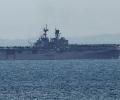
Although extensive air attacks have been carried out to destroy most of Iran's defence capabilities, the latter's resilience and sustenance during the war clearly indicate that the US landing force would encounter severe resistance in the operation, explains Commodore Venugopal Vengalil (retd).
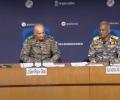
India's robust air defence system effectively thwarted Pakistani attempts to target Indian installations.

United States President Donald Trump warned Iran of potential strikes on its infrastructure, including bridges and electric power plants, saying the US military 'hasn't even started destroying what's left in Iran'.

Far from it; the country's resistance to the US, its nuclear ambitions, and its pursuit of influence and proxies across the Middle East are driven by a constant search for independence and security. Thus, Iran will never capitulate. Trump will learn this home truth ultimately, and it is going to be a humbling personal experience that may even destroy his presidency, predicts Ambassador M K Bhadrakumar.

'Without ground troops the US will not be able to oust the Iranian Islamic regime. Political change does not happen just by using bombs or planes.'
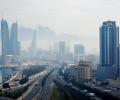
The modern war is about quality over quantity, points out Mihir S Sharma.

Specifically, military experts are assessing if the 'Octopus' interceptor anti-drone system, produced in the UK to support Ukraine in countering Russian threats, could be repurposed to strengthen British protections against Iran's Shahed drones.

Admiral Alireza Tangsiri was accused of leading efforts to disrupt maritime trade, including actions affecting the Strait of Hormuz.

Chief of Defence Staff General Anil Chauhan emphasized the need for constant high military preparedness, citing Operation Sindoor as an ongoing example. He also highlighted the importance of 'information warriors, technology warriors and scholar warriors' in future warfare.

Beijing has been wary of Sanae Takaichi's efforts to boost Japan's military profile since taking office six months ago, points out Dr Rajaram Panda.

'In a volatile global market, India is pursuing a low-risk, low-return policy, akin to a SIP -- slow, steady investment.' 'Pakistan is following a high-risk, high-return policy.'

Secretary of State Marco Rubio urged its citizens to immediately depart from several Middle Eastern countries, citing "serious safety risks."

The Indian defence ministry has initiated a project to indigenously design and develop a 1000-kg aerial bomb for the Indian Air Force (IAF), aiming to enhance self-reliance in the defence sector.

Rescue operations are currently underway, and the circumstances surrounding the incident are under investigation, the command said.

Run by the government, these mobile schools ensure that the children of the Agariya salt workers -- who migrate for months through the Little Rann of Kutch to harvest salt under extreme conditions -- don't miss out on their education.

India has expressed strong concern over the targeting of commercial shipping in the Strait of Hormuz during the West Asia conflict, urging for the restoration of unimpeded navigation and global commerce.

A new analysis by the Institute for the Study of War has warned that Iran could escalate its attacks on Israel by launching large missile salvos aimed at maximising psychological pressure on civilians.

Earlier, another state media outlet showed a display of part of the IRGC's drone arsenal inside a large tunnel. Coinciding with the release of these visuals, the IRGC confirmed the launch of the 48th phase of its retaliatory campaign.
The US President clarified that these negotiations do not involve the new Supreme Leader, Mojtaba Khamenei.
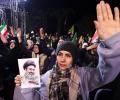
In the video, the Supreme Leader can be seen teaching religious studies to a group of pupils who are listening attentively. The IRIB said that the video of Ayatollah Mojtaba Khamenei was published for the first time.

The US blockade on Iranian ports is aimed to curb Iranian energy exports, thereby crippling its economy to force Iran back to the negotiating table, points out Commodore Venugopal Menon (retd).

On Saturday, it was reported that a drone strike had targeted the Fujairah Port in the UAE, triggering a fire.

India showcased its frontline military assets, including Brahmos and Akash missiles, at the Republic Day parade. The event also celebrated Operation Sindoor and featured a new 'Battle Array Format' for the Indian Army.

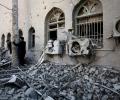
An Iranian missile strike targeted the town of Beit Shemesh, located west of Jerusalem, resulting in significant casualties and structural devastation, as reported by Al Jazeera. The strike caused extensive damage earlier Sunday to several buildings, with one structure completely collapsing under the impact.
Iranian President Masoud Pezeshkian maintained a stance of defensive necessity, noting that Tehran is "forced to retaliate to attacks" but clarified that this does not imply a dispute with neighbouring countries

Israel initiated military action against Iran shortly after Prime Minister Narendra Modi's visit, capitalising on a fleeting opportunity and years of strategic preparation, according to Israel's ambassador to India.

A French soldier was killed while several others were injured in an attack in the Erbil region of Iraq, French President Emmanuel Macron confirmed. Macron, in a post on X, confirmed that Chief Warrant Officer Arnaud Frion of the 7th Battalion of Chasseurs Alpins lost his life in the attack.
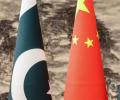
The Chinese military on Monday denied reports that its largest military cargo plane has carried arms supplies to Pakistan and warned legal action against those spreading such rumours.

The US embassy in Saudi Arabia and the US consulate in Dubai were reportedly targeted by suspected Iranian drone attacks amid heightened tensions in the Middle East following US and Israeli strikes on Iran.

Around 100 artistes heralded the parade, on the theme 'Vividata Mein Ekta (Unity in Diversity) that featured a grand presentation of musical instruments, demonstrating the nation's unity and rich cultural diversity.

The authorities confirmed that the security situation in the UAE remains stable and that all concerned entities are monitoring developments around the clock.
The logic of war plus the gathering storms in US politics as the midterms loom large leave him with no real alternative but to negotiate, points out Ambassador M K Bhadrakumar.

The Indian Air Force's Republic Day flypast will feature a 'Sindoor' formation of combat jets, symbolizing its dominance during recent hostilities. The flypast will also commemorate Operation Sindoor.
